
This article is specifically about small open commercial lots like strip malls, medical plazas, dental offices, and small office parks. Parking is shared, surface-level, and open to anyone who drives in at such properties. The enforcement toolkit for these properties is pretty narrow, and most of the solutions that exist were designed for a different problem. If you manage a multifamily property and overnight parking enforcement is your bigger issue, that’s a different problem with a different toolkit.
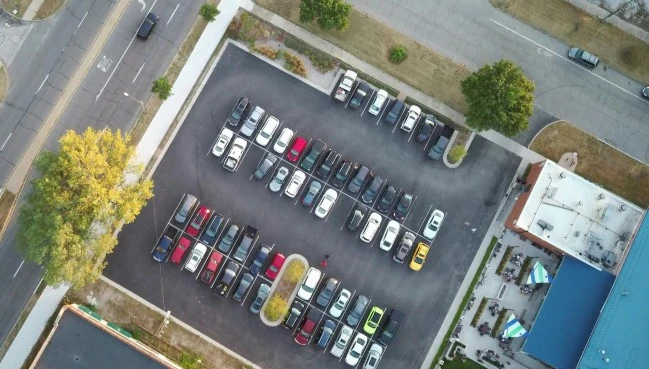
What you’re actually losing
In 2017, INRIX surveyed nearly 6,000 drivers across 10 U.S. cities and found that 39% had avoided a shopping destination specifically because of parking difficulty, and 34% had abandoned a trip entirely due to parking problems. [1] INRIX Parking Study, 2017 View source These are people who looked at a lot, decided it wasn’t worth the trouble, and went somewhere else.
A study published in Economics of Transportation found that parking difficulty cut customer traffic at two Starbucks locations by nearly 30% during periods when nearby meters made parking harder to find. [2] 'Do parking fees affect retail sales? Evidence from Starbucks', Economics of Transportation, 2014 View source That study is specifically about paid street parking, so the 30% figure doesn’t translate directly. But the mechanism is the same: when it looks hard to park, people leave.
The key word is “looks.” Your lot doesn’t have to be genuinely full. It just has to look full. A driver doing a slow roll past the entrance sees three cars spread across the front row and decides there’s nowhere to park. The overstay problem multiplies this: two cars parked all day make a 20-space lot feel like an 18-space lot every single hour. Your actual customers get the margin.
Signs
Nearly every property has them. In our home state of Washington, they’re not optional. Under RCW 46.55.070, for a time limit to be enforceable on private property, signs must be posted visibly at property entrances and must include when a vehicle may be impounded and the contact information for the authorized towing company. Without compliant signage, you can’t legally tow a violator for at least 24 hours. [3] RCW 46.55.070, Washington State private property impoundment signage requirements View source
A sign saying “2-hour parking, violators towed” is a deterrent to people who believe you’ll enforce it. Once it becomes known that you don’t (or can’t) enforce consistently, it stops being a deterrent at all.
The psychology behind why that happens
Cesare Beccaria wrote in 1764 that “crimes are more effectually prevented by the certainty, than the severity of punishment,” and 250 years of criminology research broadly backs him up. Carnegie Mellon professor Daniel Nagin, in a comprehensive review of deterrence research, put it plainly: “conventional wisdom, backed by considerable research evidence, is that the certainty of punishment, not its severity, is the more effective deterrent.” [4] Daniel S. Nagin, 'Deterrence,' Crime and Justice, Arizona State University View source Applied to parking, this means your tow sign is nearly worthless if the violator has learned that nobody enforces it.
What you can actually do about it
Before getting into the different tools, it’s worth being clear on what private property owners can legally do. Nationwide, you cannot issue a legally enforceable citation on your own commercial lot. Private “tickets” left on windshields are civil notices, just paper invoices with no legal standing. They can’t affect a driver’s license, can’t be reported to the DMV, and carry no legal authority. [5] Washington State Attorney General's Office, 'Don't ignore a parking ticket on a private lot' View source
What you can actually do is tow. Or tow with a prior warning notice, if you want to give someone a chance first. That’s essentially the full enforcement toolkit for a private commercial lot without a staffed presence.
Towing
Towing is the right tool for most situations. Fire lane blockers, strangers who have no business on your property, abandoned vehicles, repeat offenders after documented warnings: these are exactly what towing is for. You authorize it, the tow company takes the car, and the driver pays $300–500+ to get it back. It costs you nothing out of pocket.
The limitation is in the detection. You have to see the violation, confirm it meets the threshold in your signage, and make the call. For overstay violations that happen while your office is open, towing requires someone to actually notice, verify, and act. That’s more friction than most small commercial properties can absorb consistently. It’s a reactive tool that rarely catches what you need it to catch.
Mobile patrol
Patrol companies are the most direct answer to the detection gap. A marked vehicle comes through your lot on a schedule, an officer confirms violations, and they can authorize a tow or leave a warning. It’s real enforcement with real deterrence.
The cost is roughly $25–50 per visit. For a small commercial lot with genuine overstay problems, two passes a day is the minimum. For five days a week, 40–50 visits a month at $35–40 per visit is $1,400–$2,000 a month. That’s not unreasonable if parking is one of several problems you’re solving. Patrol genuinely earns its cost when your property also has vandalism, package theft, trespassing, or general security concerns. For a property where overstays are the only parking problem and it’s not consistent enough to justify daily visits, the economics are harder to make work. The other limitation is predictability. Overstay violations don’t always follow a schedule. A patrol visit is a snapshot, and violations that fall between passes don’t get caught.
Gates and barriers
For the right property, it’s the right answer. Parking garages, controlled-access office buildings, properties with a single entrance and no tenant friction: if you manage over a few hundred spaces or have a garage, there’s a strong argument that you should just gate it. The sense of control alone is worth the investment on that scale.
For a small open commercial lot shared between six tenants, none of them make sense. A typical strip mall has at least two shared driveways, each with two lanes. At $4,000–$8,000 per commercial-grade barrier arm operator plus installation and pavement work per lane, [6] Kompareit, 'How Much Does a Parking Lot Access Control System Cost?' View source you’re looking at $20,000–$45,000 before you’ve touched the access control system, intercoms, or maintenance contracts, which are recommended every 6–12 months. [7] Alibaba Buying Guide, 'How to choose a parking lot lift gate' View source There’s a reason they’re so uncommon for retail.
LPR cameras
Flock Safety is probably the most well-known name in this space right now. Their Falcon camera runs $2,500 per camera per year with a one-time $250 installation cost. [8] Flock Safety Falcon camera pricing, Campbell, CA FAQ View source
The issue is what it’s built to do. Flock is designed for crime investigation and vehicle theft. The Campbell, California police department, which uses Flock extensively, explicitly notes that their cameras “are not intended for minor traffic or parking violations.” [9] Campbell Police Department on Flock Safety usage View source LPR logs plates and timestamps when vehicles pass the camera’s field of view. It physically can’t alert you that a specific car has been in spot 8 since 7:30am. Someone still has to query the system, cross-reference arrival times, and make a judgment call. There’s no automated detection of overstays, just a database you have to proactively dig into. LPR is solving a different problem.
The gap
The properties that have a perfect solution are the ones with money and infrastructure: gated garages and staffed front desks.
What’s missing for small open commercial lots is something in between “signs and the occasional tow” and a staffed or gated presence. Continuous monitoring that doesn’t require building a checkpoint at every entrance, doesn’t cost $2,000 a month, and actually catches the 9am-to-5pm squatter rather than logging them after the fact.
What we’re building
With objectivity out of the way, here’s our pitch. ParkingLens uses the outdoor security cameras your property already has to detect overstaying vehicles automatically, without any new hardware. The system identifies vehicles that exceed the time threshold you set and sends an alert so you can act on it however you wish. We’re significantly cheaper than mobile patrol, and we watch continuously.
If you manage a commercial property and parking overstay is eating into your tenants’ customer traffic, see if your property qualifies.